
What each kind actually is
The names overlap in showrooms, so it helps to separate them by how they are installed rather than how they are marketed.
A portable model on casters deserves its own mention for renters: it needs no cabinet opening, clips onto the faucet when in use and rolls into a corner afterward.
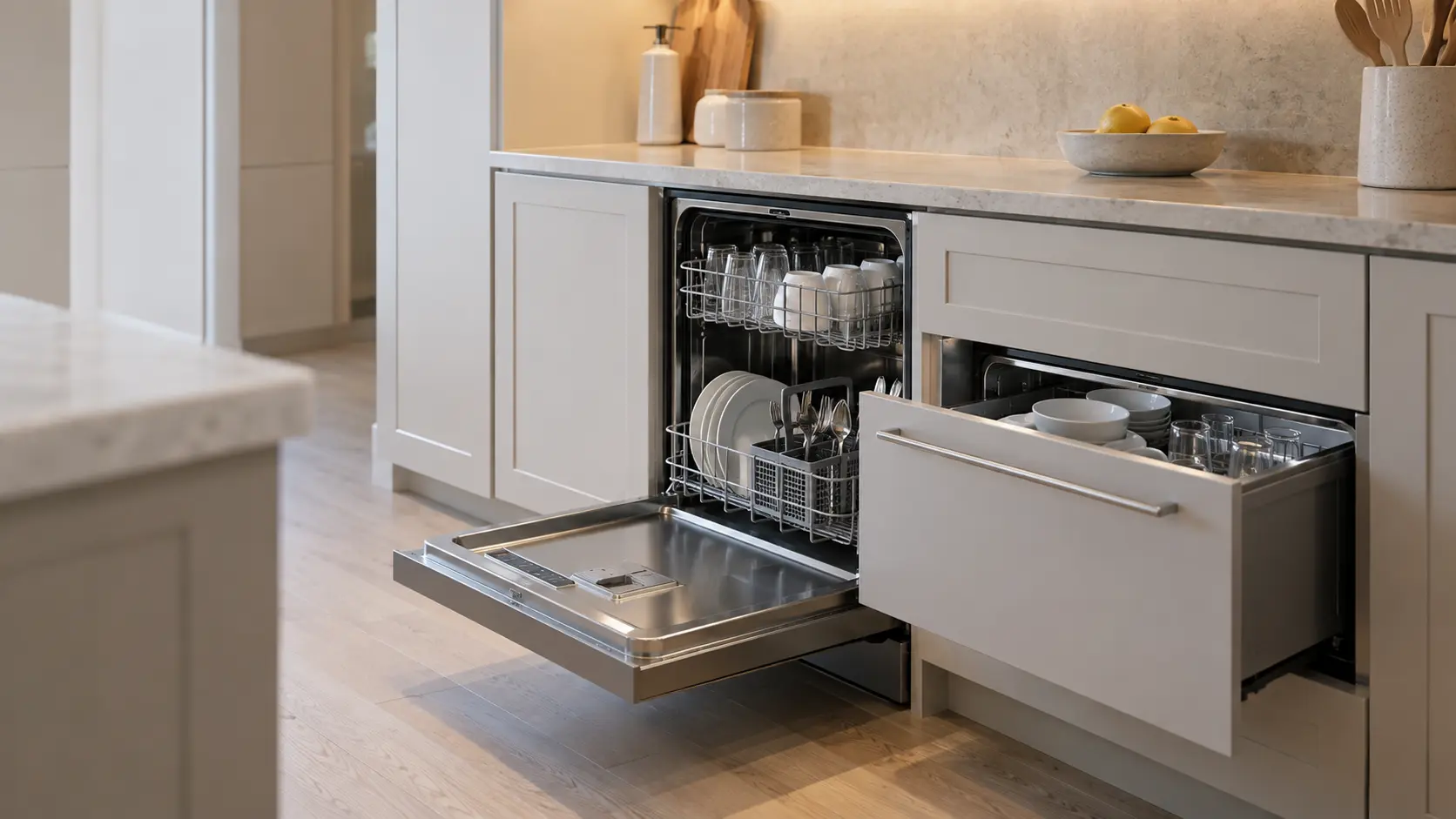
- Standard built-in: a single 24-inch tub under the counter, fixed with brackets, with one door that folds down.
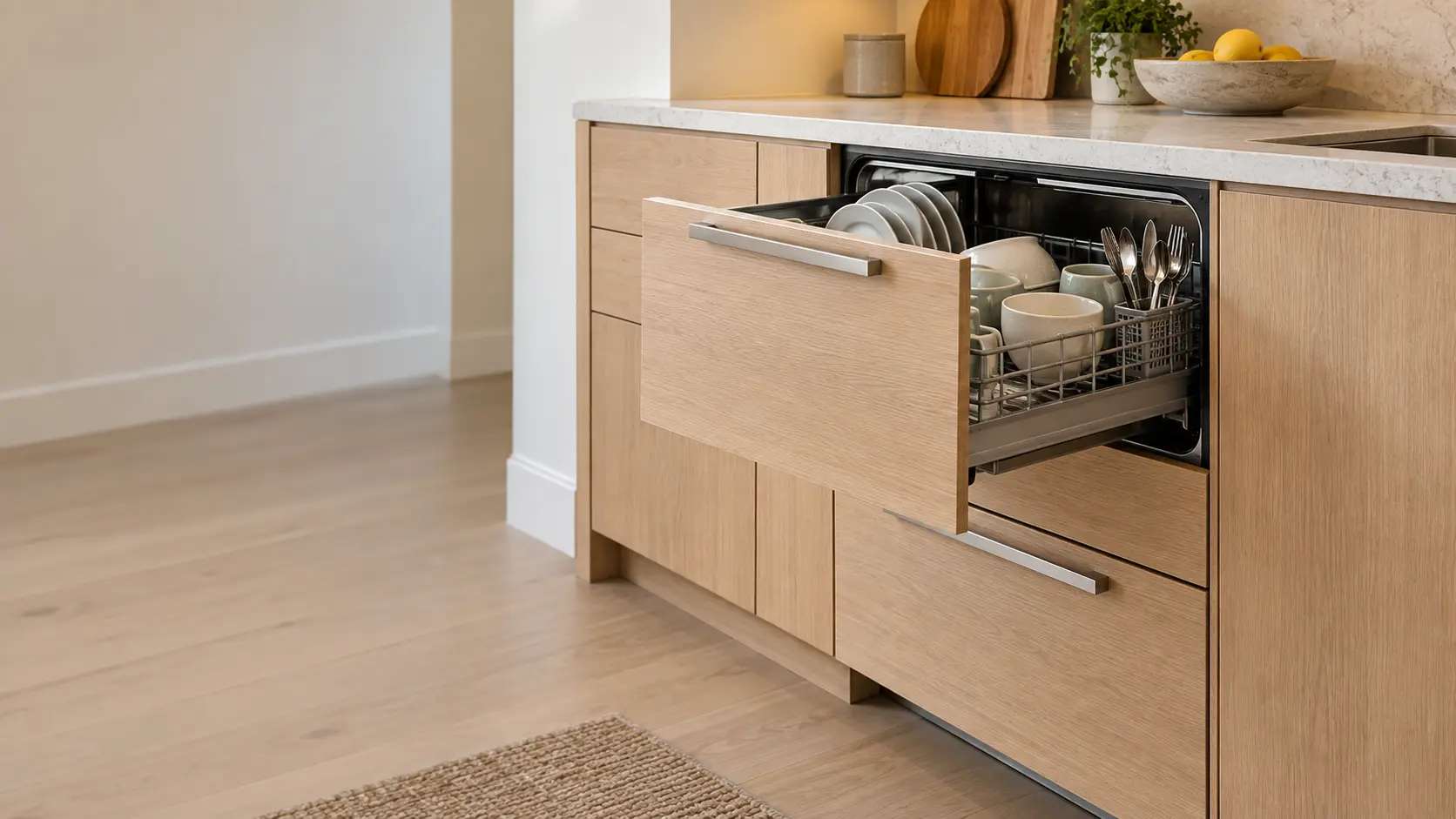
- Drawer: one or two shallow tubs on runners, pulled open like a kitchen drawer, and each one washes independently.
- Eighteen-inch built-in: a slimmer version of the standard machine, installed the same way in a narrower gap.
- Countertop or portable: a small freestanding machine that sits on the counter or rolls on casters and borrows the kitchen faucet.
Capacity and what really fits
ENERGY STAR sorts machines by capacity rather than width: a compact holds fewer than eight place settings and six serving pieces, and anything larger counts as standard. Many 18-inch models clear that line, so a narrow machine is not automatically a compact one in the rating sense.
Tall items and awkward pieces
Height is where drawers give the most away. A single drawer tub is shallow, so stockpots, tall vases and large platters often have to be washed by hand. A standard built-in with an adjustable upper rack takes most tall pieces on the bottom rack without trouble.
Small households and half loads
A couple who fill a full-size tub every three days may be better served by one drawer that runs daily, with the second held for dinner guests. Dishes do not sit dirty for days, and odor from a half-filled tub stops being an issue. The trade-off is that a big family often runs both drawers every evening and ends up with less total space than a single large tub.
Reach and accessibility
An upper drawer mounted at waist height removes most of the bending, which matters to owners with back trouble or in wheelchair-accessible kitchens. A conventional door that drops to horizontal needs clear floor space in front of it; a drawer needs less swing room but more pull-out depth.
Source: ENERGY STAR — Dishwashers key product criteria (standard and compact capacity) — Compact means fewer than 8 place settings plus 6 serving pieces

What each kind is like to own and repair
This is the part showrooms skip. The mechanics decide how often a visit happens and how long it takes.
Standard built-in
The pump, valve and heater sit in the base behind the toe kick and are reached from the front. Parts are widely stocked, and most models share the same layout ideas across makers, so a technician rarely meets a surprise.
Drawers
Each drawer closes against a lid with a seal that has to hold water every cycle, and that seal is the part owners should expect to replace sooner or later. Two drawers mean two pumps, two sets of electronics and a flexible cable that follows the drawer in and out. Repairs are usually done in place, but parts come from fewer suppliers.
Compacts
An 18-inch machine is serviced much like its wider sibling, with less room to work under the tub. Countertop units rely on a faucet adapter and hoses that crack with handling; beyond those, a failed pump or board usually means buying another machine.
Drying, noise and cycle length
Owners comparing kinds often expect a smaller tub to finish faster. In practice cycle length is set by the program and the water temperature, and a small machine running its normal cycle can take as long as a full-size one.
Drying differs more. A tall stainless tub holds heat and gives condensation a large cold surface to collect on, which is how many modern machines dry without a heating element. A shallow drawer has less wall area, so plastic containers and cups with hollow bases may come out damp unless rinse aid is kept topped up.
- Check the published noise rating in decibels; a lower figure is quieter, and a few points make an audible difference.
- Look for a half-load or upper-rack-only option on a standard machine before paying for drawers to get the same flexibility.
- On countertop models, remember that the machine drains into the sink, so the sink must be clear whenever it runs.
Fitting the kitchen you have
Measure before choosing. The opening width, the height under the counter and the location of the sink cabinet matter more than the brochure.
For most remodels the real dishwasher drawer vs built-in decision comes down to two numbers: how many place settings the household dirties in a day, and whether anyone in it struggles to bend to a low rack.
- Width of the gap between cabinet boxes, measured at the top and at the floor.
- Clear height from the finished floor to the countertop, which new tile or wood can reduce.
- Distance to the sink base, where the supply valve, drain and outlet usually are.
- Whether the counter is stone, since mounting brackets may have to fix to the side cabinets instead.
Converting one opening to another
Swapping a 24-inch built-in for a double drawer normally fits the same width, though the drawer may need specific clearances and a particular outlet position. Going from 18 to 24 inches means cutting down a cabinet, which turns an appliance purchase into a small remodel.


