


Dishwasher
Tripping the Breaker
The breaker or GFCI outlet cuts power at the start of a cycle, during heating or at random.
Mon–Sat, 8am–8pm
- Water or wiring at risk
- 5 questions that narrow it
- 5 causes, cheapest first
Book a visit
Three short steps, about a minute.
or call (844) 430-4286
Loading appointment form…
The appointment form couldn’t load. Please try again.
Stop the water and power first
A breaker that trips is doing its job. Leave it off, close the supply valve under the sink if there is water in the tub, and do not bypass the GFCI or swap to a larger breaker. If you see scorching, smell burning, or feel a tingle touching the door, keep everyone away from the machine until it is checked.
What it
usually means.
A breaker trips because the circuit sees more current than it should, or because current is leaking to ground. On a dishwasher, the heating element and the motors draw the most, and water is never far from either. When the trip happens is the most useful clue: at the moment the machine starts, when it begins to heat, or only when the disposal on the same circuit runs.
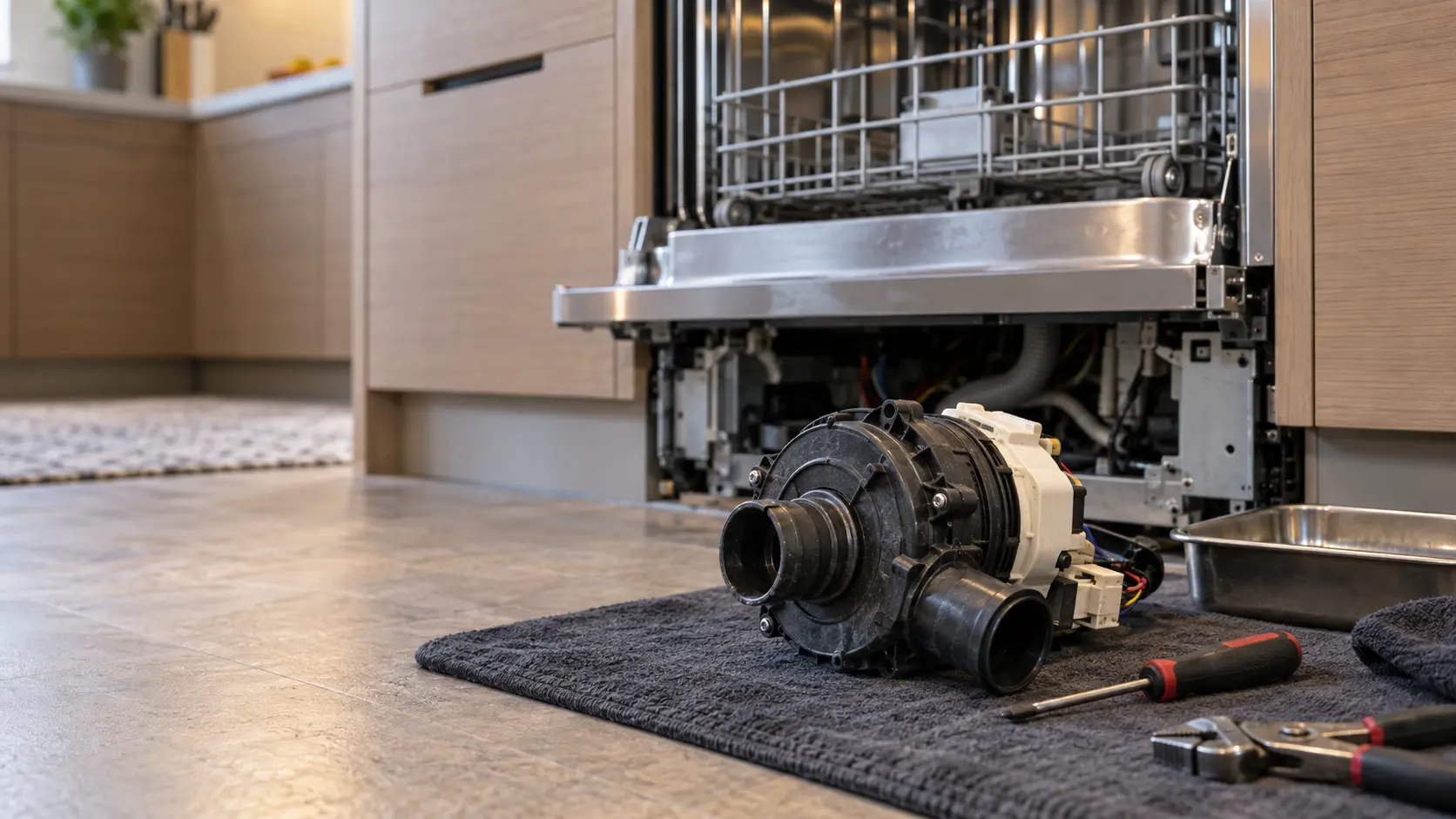 The 5 causes, cheapest first
Answer these first
Does it trip the instant the cycle starts, or several minutes in when the water heats?
Is the dishwasher on a GFCI outlet or a GFCI breaker, or a standard breaker?
Does the garbage disposal or another appliance share the same circuit?
Was there a leak or water under the machine shortly before this started?
Does it trip on every cycle, or only now and then?
Check these
before you book.
Dishwasher tripping breaker: 5 checks, and none of them costs anything.
Leave the breaker off after the second trip; resetting it again and again can damage wiring.
Check for water under the dishwasher by removing the kick plate once power is off.
Find out whether the disposal or another appliance shares the circuit, and whether both were running.
Also worth checking
- Note the point in the cycle where it trips; heating and startup point to different parts.
- Check whether the outlet under the sink is a GFCI with its own test and reset buttons.
The causes,
cheapest first.
5 things dishwasher tripping the breaker turns out to be, from shared or undersized circuit to wash or drain motor drawing too much current.
The cost guide-
01 no repair
Shared or undersized circuit
A dishwasher and disposal on one 15-amp circuit can trip it when both run. That is a wiring layout question, not a dishwasher repair.
-
02 low to moderate
Heating element shorted to ground
An element with a cracked sheath leaks current to the tub, which trips a GFCI as soon as heating begins. It is the most common cause.
-
03 low to moderate
Water reaching wiring under the tub
A leak that drips onto the terminal block or a motor connector creates a path to ground. Fixing the leak and drying the wiring may be all it needs.
-
04 low
Damaged power cord or junction box connection
A pinched cord or a loose wire nut in the junction box shorts intermittently, which is why the trip can seem random.
-
05 moderate
Wash or drain motor drawing too much current
A seized or failing motor pulls far more than its rating at startup, which trips the breaker when the circulation or drain step begins.
-
What it costs
Every repair on the site's cost scale, side by side
Open the cost guide
What else
it could be.
Most often confused with dishwasher burning smell, then dishwasher not heating water.
All problems

The makes
it happens on.
27 makes on this site; dishwasher tripping the breaker can show up on any of them. Each mark opens that make's own page.
All 27 brandsDishwasher Tripping the Breaker,
where we come out.
9 metros, each with its own page.
All service areasTampa BayFL · 31 areas
Miami / South FloridaFL · 47 areas
New York MetroNY · 75 areas
HoustonTX · 36 areas
ChicagoIL · 50 areas
Los AngelesCA · 95 areas
San DiegoCA · 31 areas

Questions about
dishwasher tripping the breaker.
Can I just move the dishwasher to a bigger breaker?
It only trips the GFCI, never the main breaker. What does that mean?
Is it safe to run the dishwasher with the breaker reset until the visit?
Could the problem be the outlet rather than the dishwasher?
Back to your everyday
Still seeing dishwasher tripping the breaker?
Book with what you checked above — 5 answers save the technician the first part of the visit.