

Where dishwasher failures land on the cost scale
Before weighing a new machine, place the failure in its band. Most calls we see are for something at the bottom of the scale, and owners who assume the worst sometimes buy a whole appliance to cure a clogged hose. From least to most expensive:
- The cheapest kind of repair: a blocked filter or drain hose, a stuck float, a torn door gasket, a dispenser spring.
- The low band: drain pump, inlet valve, door latch and switch, hinge springs or cables.
- Moderate: the heater or its thermistor, a wash motor, a diverter, a replacement control board.
- The top of the scale: a tub leak that cannot be sealed, or a board and a motor failing together on an old machine.
Why the bottom band dominates
A dishwasher moves dirty water through the same narrow passages hundreds of times a year. Seeds, labels, broken glass and grease collect in the sump and the drain line long before anything electrical wears out. That is why a no-drain or poor-wash complaint usually ends with cleaning or a single part, not a verdict on the machine.
The control board question
Boards are the part that most often tips an owner toward a new unit. A board fails less often than people think, and many apparent board problems turn out to be a latch switch or a wiring connector at the door hinge. When a board truly has failed, the deciding fact is whether the maker still supplies it for your model number.
Signs the machine is finished
A few conditions make repair poor value however new the dishwasher is. A technician worth hiring will point them out rather than quote around them.
- Rust spots that have eaten through the inner tub, or a crack in a plastic tub near the heater or the sump.
- A steel base pan that has rusted from years of a slow leak, often with soft or stained flooring underneath.
- Door hinges torn out of the side walls, rather than broken springs, which can be replaced.
- A control board that is no longer produced, with no listed substitute.
- Racks, wheels and door liner all worn at once on a unit that also needs a moderate-band part.
How the type changes the answer
The same broken pump can mean very different things on different installations, because the real cost of replacement is set by the opening and the front.
| Type | Usual answer | Main reason |
|---|---|---|
| Standard 24-inch built-in, low-band part | Repair | The part is inexpensive and reached from the front |
| Standard 24-inch built-in, past ten years, moderate part | Either; lean replace | New units fit the same opening and plumbing |
| Panel-ready | Repair in most cases | A new model must accept the existing panel |
| Drawer | Repair in most cases | Few replacements fill a drawer opening |
| Any type with a leaking tub | Replace | The tub cannot be rebuilt economically |
A standard built-in with its own door
Most American kitchens have a 24-inch opening under a counter of standard height. Almost every maker builds to it, so a replacement slides into the same gap and reuses the existing supply valve and drain connection. Here age deserves real weight: a machine past ten years that needs a moderate-band repair is a fair candidate for replacement.
Panel-ready machines and drawers
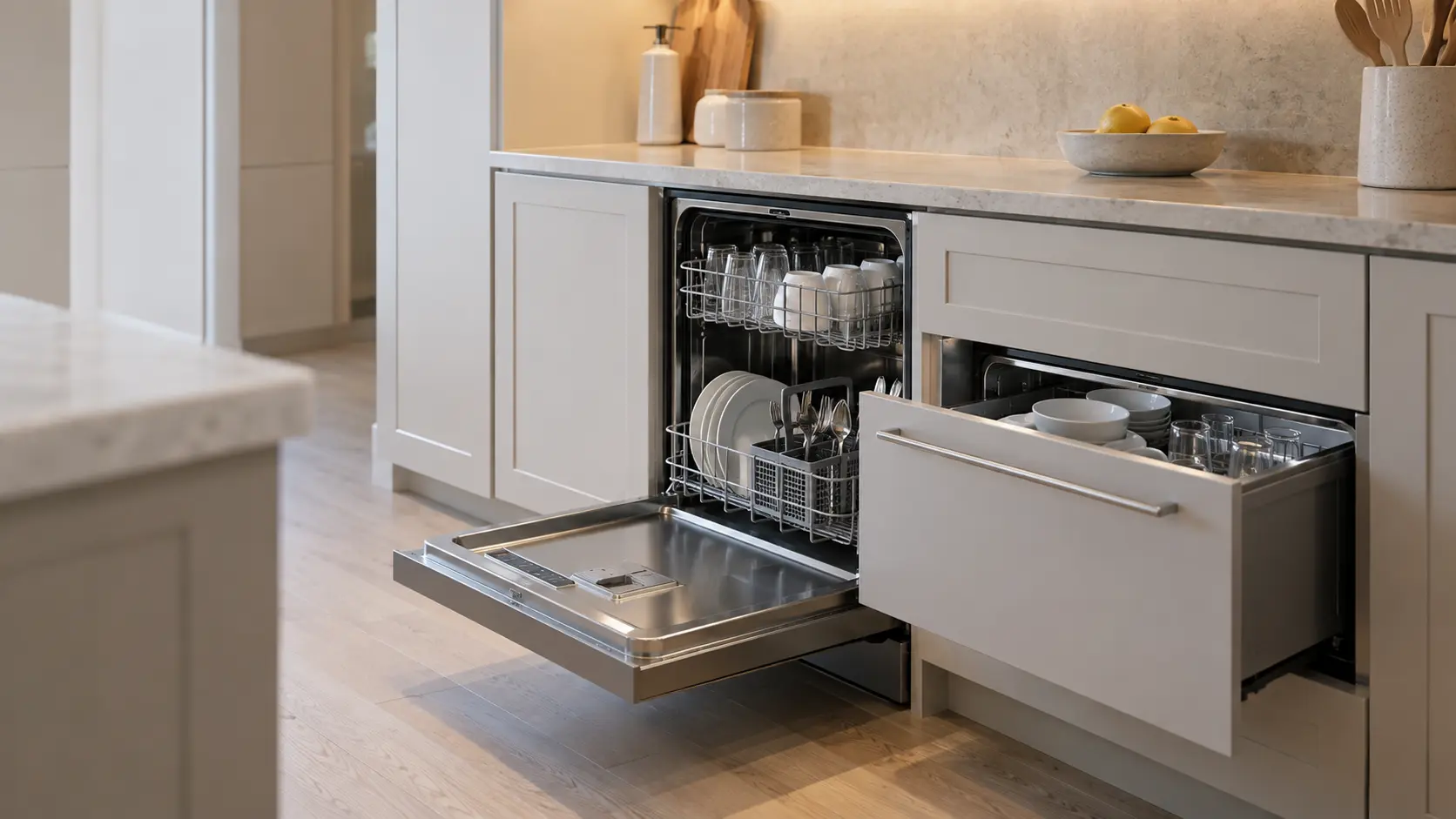
When the door wears a cabinet panel, a new machine must match the panel's mounting pattern, weight range and height, or the panel has to be remade. Double drawers are rarer still, and a two-drawer opening cannot take a standard machine without new cabinetry. Both are designed to be serviced in place, and repair wins in most cases.
Eighteen-inch and countertop compacts
An 18-inch built-in has fewer replacement options than a 24-inch one, though the choice is far from empty. A countertop model that connects to the faucet is the one case where replacement is almost always the sensible move for anything beyond a hose or a filter.
Water and energy in the decision
Efficiency rarely justifies scrapping a machine that works. It is a reasonable tiebreaker when a large bill is already on the table. ENERGY STAR currently caps a certified standard-size model at 3.2 gallons per cycle, and older machines were allowed noticeably more.
The bigger difference in daily running often comes from how the old machine is used. A unit that needs a prewash at the sink and a second cycle for half the loads wastes more water than any rating reveals, and that habit is itself worth a diagnosis.
Source: ENERGY STAR — Dishwashers key product criteria — Certified standard models use at most 3.2 gallons per cycle; ENERGY STAR — Dishwashers — Rinsing dishes before loading increases total water and energy use
Settle it in three steps
Guessing leads owners to replace too early or to pour money into a tub that is already gone. The honest way to repair or replace a dishwasher is to answer three questions about your own machine, in this order, before anyone quotes for either option.
It also helps to write down what the machine did in the days before it stopped: a hum without draining, a burning smell, water on the floor only when the door opened. Those details often place the failure in a band before the kick plate even comes off.


