

Why the exact model number matters
Two dishwashers that look identical in a showroom can use different pumps, control boards and door springs, and a single model family may run through several engineering revisions. Parts are ordered by the full model number, including the suffix after the dash or the last few characters, and the wrong suffix is the most common reason a replacement part does not fit.
The same number opens the owner's manual and the installation instructions on the manufacturer's site, the error code tables that apply to that control, and any safety recall. The Consumer Product Safety Commission publishes recalls in a searchable list, so checking once when you find the label is worthwhile.
Source: CPSC — Recalls and Product Safety Warnings — CPSC publishes product recalls in a searchable list
Where to look, type by type
Standard built-in
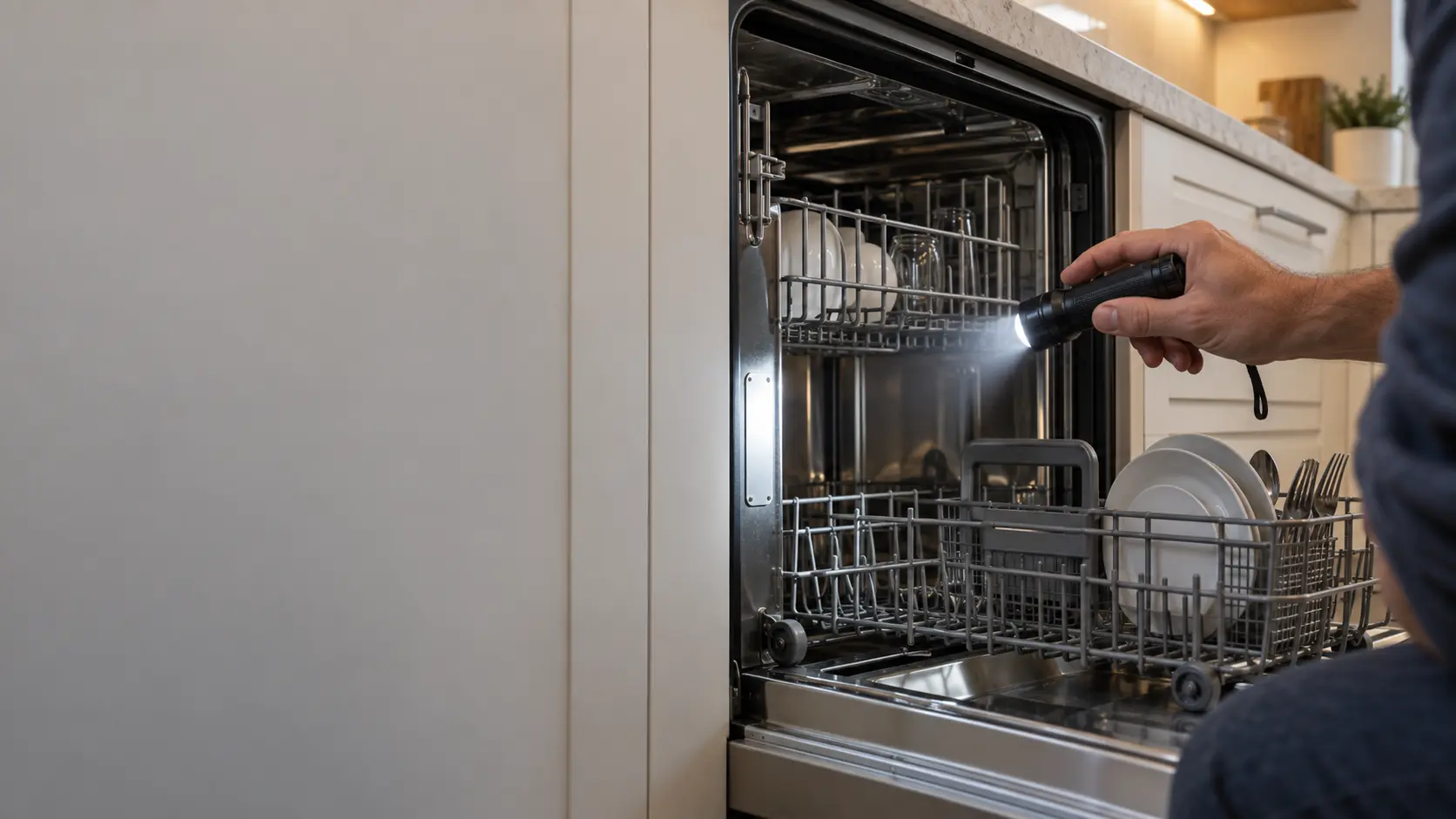
The usual dishwasher model number location on a full-size built-in is the tub opening. Open the door all the way down and look at the vertical edges of the opening, first the left side, then the right. The label is a white or silver sticker, often with a barcode, about the size of a business card. If the sides are bare, look along the top edge of the door itself and at the inner door liner near the hinge.
Panel-ready and hidden-control models
The cabinet front covers only the outside of the door, so the label is still inside: on the tub edge or on the top edge of the door, next to the buttons. On some European models it sits on the door edge right under the control strip, and the door has to be opened fully to read it.
Dishwasher drawers
Pull the drawer fully out and look at the side of the drawer frame or the front edge of the tub. In a double stack each drawer may carry its own label, but the model number for ordering usually refers to the whole product, and the serial helps tell the two drawers apart.
Compact and portable models
A built-in compact follows the full-size pattern, on the tub or door edge. Portable and countertop models often place the label on the back panel or one side, where it is easier to reach by turning the machine than by opening it.

Reading the label correctly
The label usually shows several codes. Only one is the model number, and it is marked as MOD, Model, Model No. or E-Nr, depending on the brand. The others are just as useful once you know which is which:
- Serial number (S/N): identifies the single unit, and on many brands its characters encode the production month.
- Electrical rating: volts, amps or watts, which matter if the circuit is ever questioned.
- Product or type code: an internal family code that parts catalogs sometimes use as well.
- Build date: printed plainly on some labels, shown as a short production code such as FD on some European brands, or hidden in the serial on others.
Source: Bosch — Product number (E-Nr.) and production number (FD) — Bosch prints the E-Nr and FD numbers on the rating plate
When the label is faded or gone
Steam and detergent fade labels on the tub edge over the years. Try a flashlight held at a low angle, or a photo with the flash on, which often picks up print the eye cannot read. The original paperwork, the installation guide in the kitchen drawer, or the purchase receipt may carry the same number.
If none of those survive, a technician can often identify the model from the control panel layout, the rack design and the parts in the base. That takes longer, so it helps to say in advance that the label is unreadable.
Putting the number to use
With the number in hand, type it into the support search on the manufacturer's website. Owners usually look for the manual and forget the rest, but the number unlocks four separate documents:
The installation guide is the one most often overlooked, and it is where the drain hose height, the supply requirements and the bracket layout are written down for that exact machine.
Include the model number when you describe a problem to any repair service. It tells the technician which control, pump and latch design to expect, which parts are likely to be needed, and which diagnostic mode the control offers. A visit that starts with the right parts on the truck is more likely to finish in one trip.
Keep the photo somewhere you will find it in a hurry, such as a note on your phone or a folder with the home warranty paperwork. A dishwasher usually outlasts the memory of which one was bought.
- The use and care guide, for cycle options and routine cleaning
- The installation instructions, for hose, supply and bracket details
- The parts diagram, which shows every part number for that exact build
- Any open recall that lists the model
Source: CPSC — Recalls and Product Safety Warnings — CPSC publishes product recalls in a searchable list


