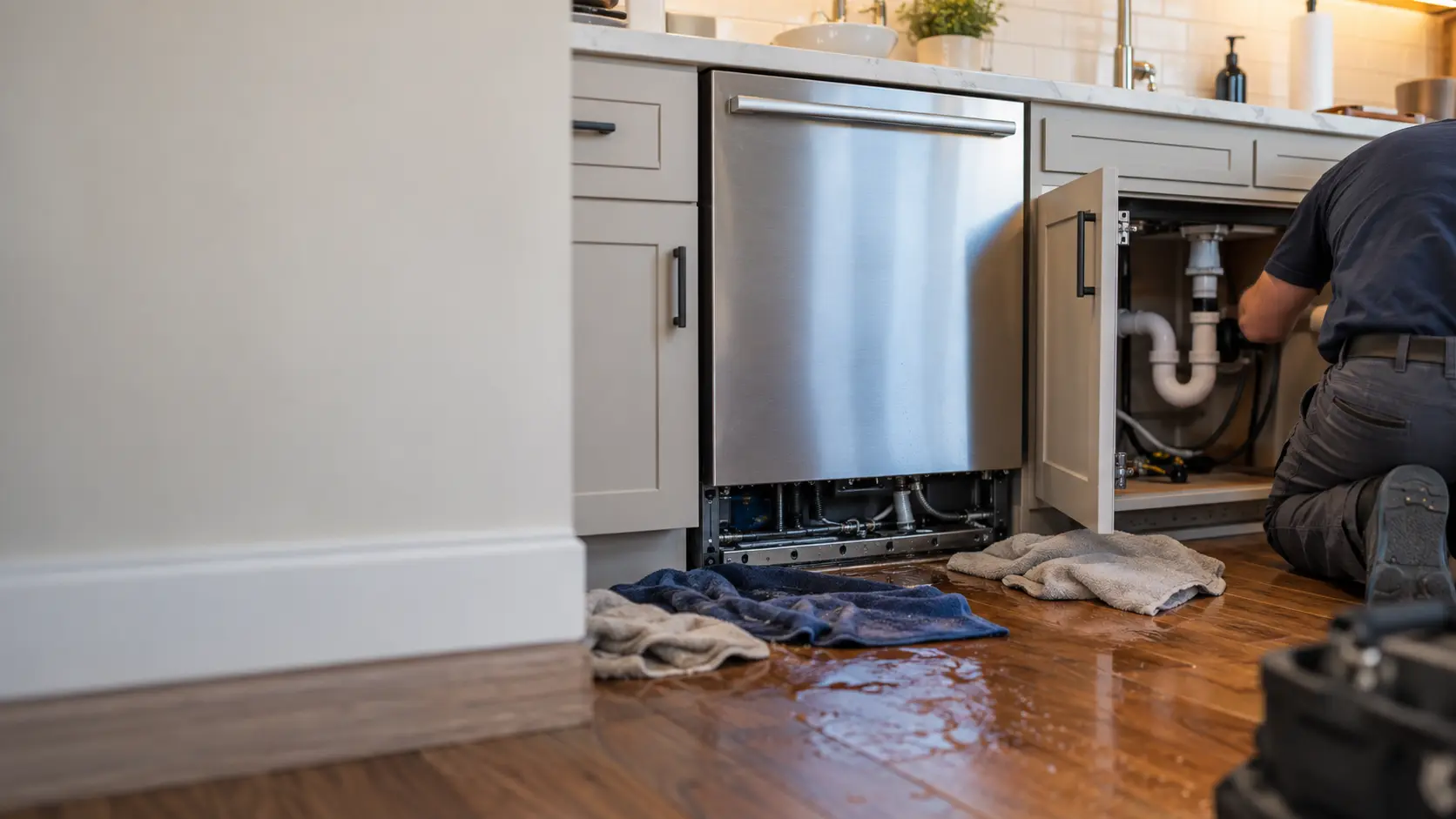

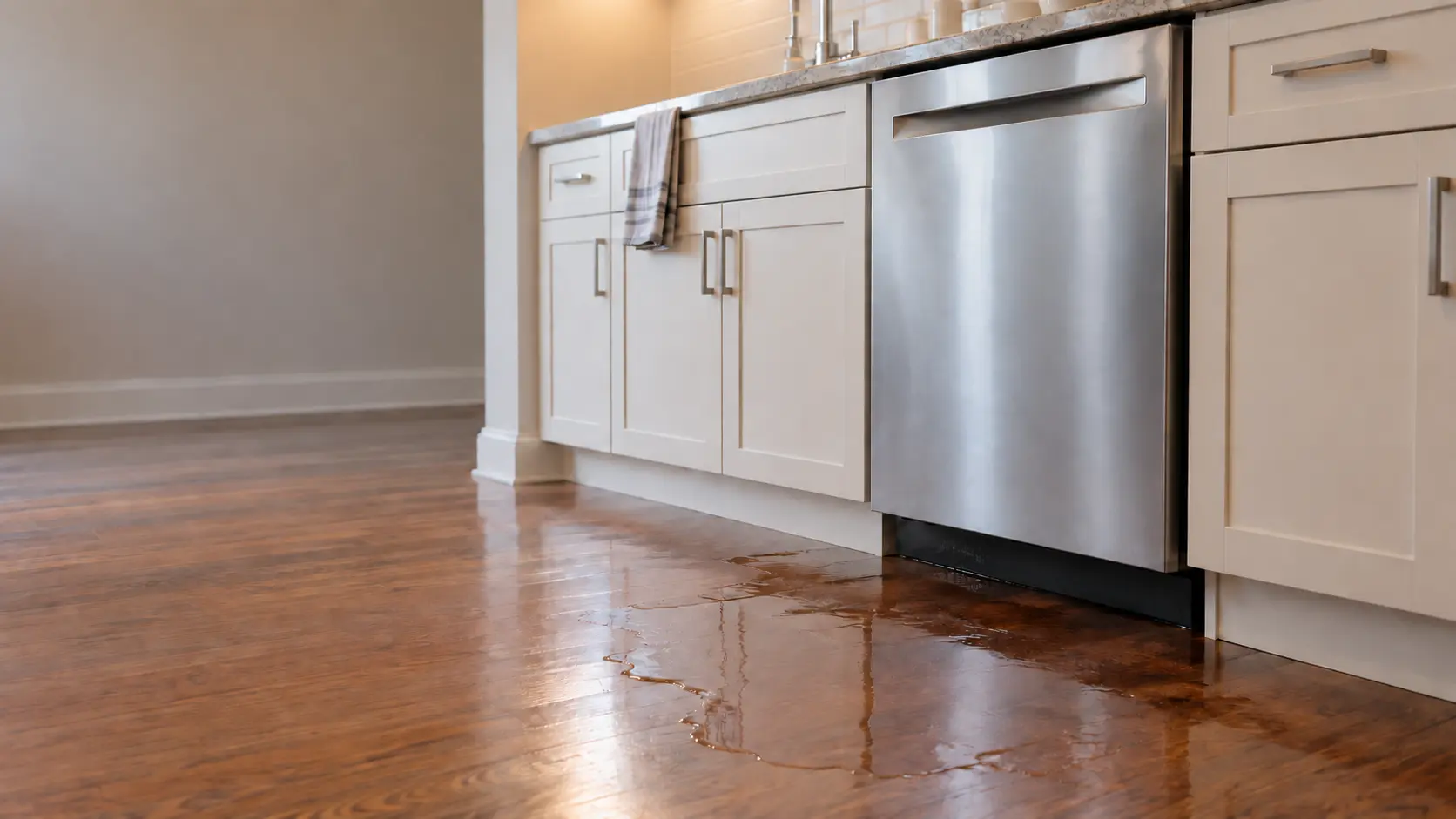
The first half hour
A dishwasher takes in only a modest amount of water per fill, but a supply fitting that has split, or an inlet valve that sticks open, keeps feeding water for as long as the house supply is on. That is why the order below starts with stopping the flow and cutting the power, and only then turns to towels.
Work through it in this sequence even if the puddle looks small. What is visible on the tile is often the overflow from water that has already run under the cabinets.
- Press cancel or open the door to stop the cycle.
- Switch off the breaker labeled for the dishwasher, or for the kitchen if nothing is labeled.
- Open the sink base and close the valve that feeds the dishwasher line.
- Soak up standing water with towels and a wet-dry vacuum if you have one.
- Take photographs before anything is moved or thrown away.
Finding the valve under the sink
In most American kitchens the dishwasher takes its water from the hot supply to the kitchen faucet. Look at the chrome shutoff on the hot pipe: a dual-outlet valve has one tube going up to the faucet and a second, often braided stainless, going sideways through the cabinet wall toward the dishwasher. Some installs use a separate single valve, and a few older ones tap the line in the basement or crawlspace below.
When that valve will not turn
Multi-turn valves that have not moved in a decade can seize or start weeping at the stem when forced. If it resists firm hand pressure, stop rather than reaching for pliers, and close the main shutoff for the house instead, which is usually near the water meter, the water heater or where the line enters the basement.
The breaker or the plug
Many dishwashers are hardwired into a junction box behind the kick plate, so there is no plug to pull. Others have a cord running to an outlet inside the sink base, which you should not unplug while standing in water or reaching through a wet cabinet. The panel is the safer route in both cases.
Where the water goes that you cannot see
A built-in sits in a pocket between two cabinets, on whatever flooring was laid before it went in. Water that escapes underneath follows the lowest path: along the subfloor under the neighboring base cabinets, into the gap behind the toe-kicks, and down any penetration where the pipes come up through the floor. In a second-floor kitchen it can show up as a stain on the ceiling below before anyone notices the kitchen floor. Most dishwasher water damage we see on visits is of this hidden kind, found weeks after the leak began.
Slow leaks do more harm than dramatic ones because nobody reacts to them. These are the signs that one has been going on for weeks:
- A soft or springy spot in the floor just in front of the door
- Laminate or vinyl plank that has lifted or swollen at the seams near the machine
- Hardwood boards that have cupped, with edges higher than their centers
- A dark line or peeling finish along the bottom of the adjacent cabinet toe-kicks
- A musty smell inside the sink base, or a warped cabinet floor there
Drying out the cabinet and floor
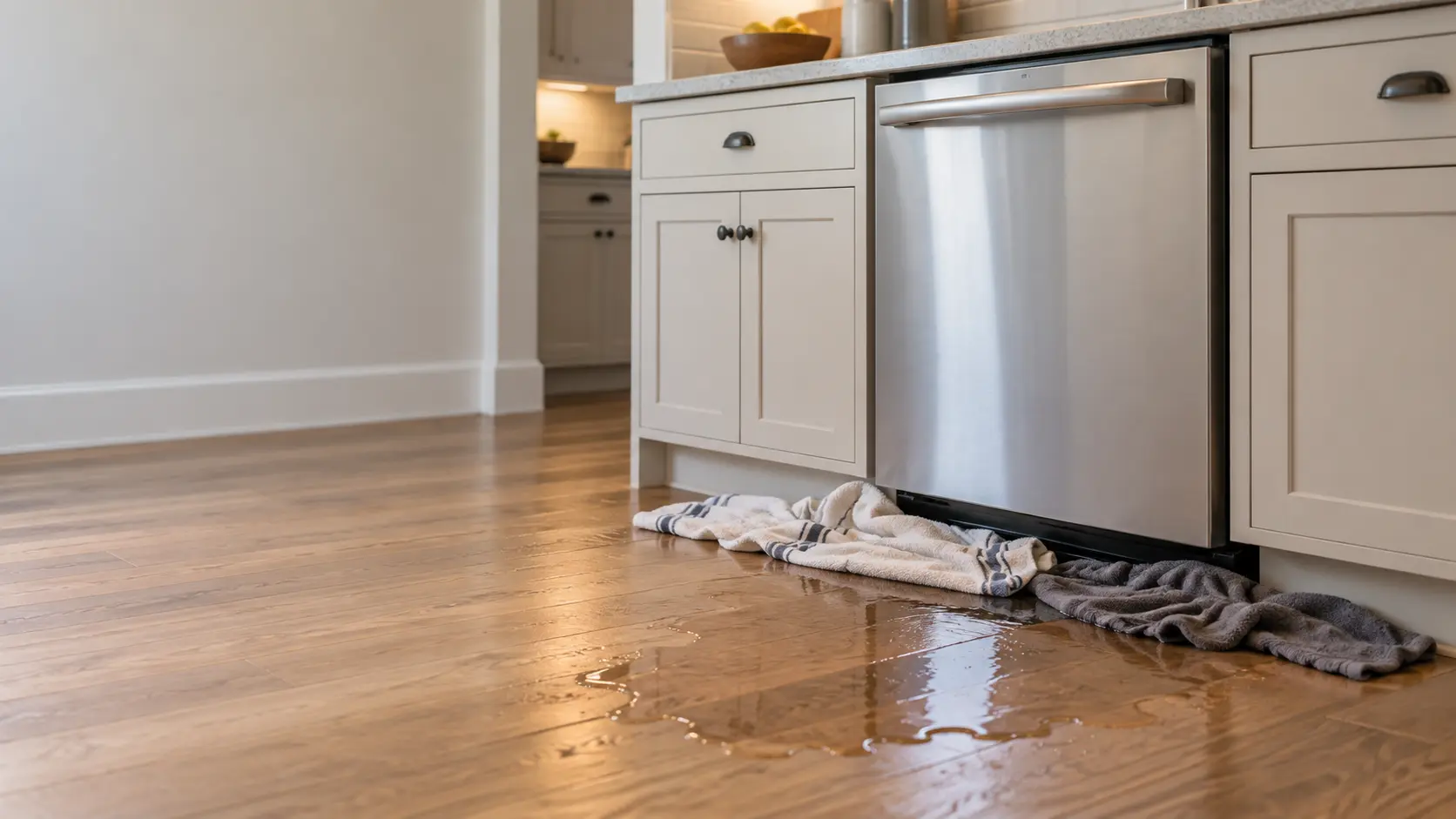
EPA's mold guidance says wet building materials should be dried within 24 to 48 hours to keep mold from growing. A kitchen floor will not dry on its own that fast if the water got under the machine, because the dishwasher and the cabinets seal it in.
Open every door of the sink base and the cabinets on either side, and remove what is stored there. Point a fan at the kick-plate opening and run a dehumidifier in the room with the windows closed.
Whether the machine needs to come out
If water sat for more than an hour or the flooring is already lifting, the subfloor under the machine will stay wet until the dishwasher is pulled. That means releasing its mounting screws, disconnecting the supply and drain and sliding it out, which is a job for whoever will reinstall it.
Materials that rarely recover
Particleboard cabinet floors and laminate flooring swell when soaked and seldom flatten again. Solid wood, tile and plywood usually come back if they are dried promptly, and a moisture meter reading taken a few days later settles the question better than touch.
Source: EPA — A Brief Guide to Mold, Moisture and Your Home — Dry water-damaged areas within 24 to 48 hours to prevent mold
Reading the leak before it is repaired
Where the water collected, and when it appeared, is the most useful information you can hand a technician. Water only in front of the door usually traces back to the tub opening or to suds. A wet area under the sink base points toward the drain hose or its connection. Water that returns after the machine has been idle for a day, with the valve still open, points at the supply side, since that part of the system is under pressure all the time.
Write down the time of day, the cycle that was running and what detergent was in the dispenser. If the leak stopped on its own once the valve was closed, say so; it narrows the list considerably.
Records worth keeping
Homeowner policies often treat a sudden burst differently from damage that built up slowly, and the wording varies by insurer. Photographs taken before cleanup, with the date, help either way. So does keeping any failed part, such as a split supply line or a cracked fitting, in a bag rather than throwing it out.
If a restoration company is called, ask for their moisture readings in writing. They show which areas were wet and when they were measured dry, which matters if the flooring has to be replaced later.
Catching the next one early
A battery water alarm on the floor of the sink base costs little and sounds within seconds of water arriving. Several models connect to a phone, which helps in a house that sits empty during the day.
Many current dishwashers have a float in the base pan that starts the drain pump and shows an error when water collects there. It protects the floor from the tub, not from a leaking supply line upstream of the machine, which is why the braided hose and its valve deserve a look at every filter cleaning.
Source: EPA WaterSense — Fix a Leak Week — Leak detection devices alert you to leaks and reduce water damage; Whirlpool — F8E4 error code — Water in the drip tray trips a float switch and starts a drain


