
Before you touch the panel
A circuit breaker exists to stop wiring from overheating, and a GFCI exists to stop current from finding its way through water or a person. When either one acts under a dishwasher, the machine has just done something the circuit refused to carry. Give it a few minutes before doing anything.
Leave the door closed if you saw smoke, so there is less air feeding anything that is smoldering, and keep the breaker off. Then go through these before any reset:
- Smell at the door vent and at the kick plate, and note which is stronger.
- Look along the floor in front of the machine for water.
- Check whether the disposal, a microwave or a countertop appliance was running at the same moment.
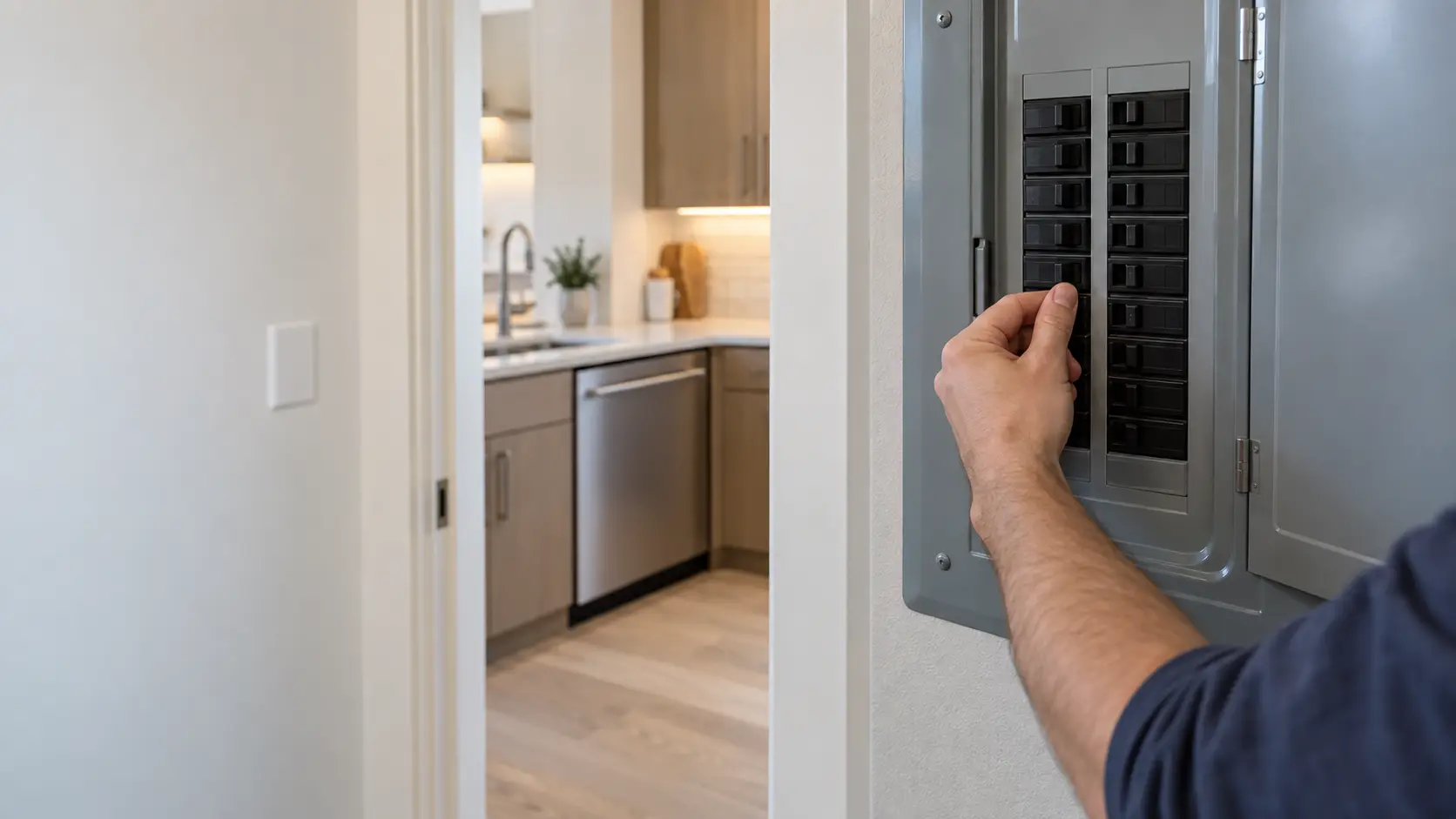
- Find out which device tripped: a breaker in the panel, a GFCI breaker with a test button, or a GFCI outlet in the sink base.
Two kinds of protection, two different messages
The difference between the devices matters, because they trip for different reasons and point at different parts.
A standard breaker
An ordinary thermal-magnetic breaker opens when the circuit carries more current than its rating for long enough. On a dishwasher that usually means two loads at once on one circuit, a motor struggling to turn, or a dead short in the wiring. GE's installation instructions, as one example, call for an individual grounded circuit on a 15- or 20-amp breaker, and a kitchen that shares it with the disposal is the first thing an electrician looks at.
A GFCI breaker or outlet
A GFCI compares the current going out on the hot wire with the current returning on the neutral. CPSC describes it as shutting power off faster than a blink of an eye when the two differ by as little as 0.006 amperes, because the difference is leaking to ground. Under a dishwasher, water is the usual path, and the heating element and the wiring near the pump are where it finds one.
When in the cycle it trips
A trip the moment the start button is pressed points toward the wiring or a component shorted outright. One that arrives several minutes in, as the water begins to warm, points toward the element. A trip only at the drain step, or only when the disposal runs too, points toward a motor or the shared circuit. Writing this down saves most of a diagnostic visit.
Source: CPSC — GFCI Fact Sheet — A GFCI cuts power when outgoing and returning current differ; GE Appliances — Built-In Dishwasher Installation Instructions — Individual grounded circuit with a 15- or 20-amp breaker

Reading the smell
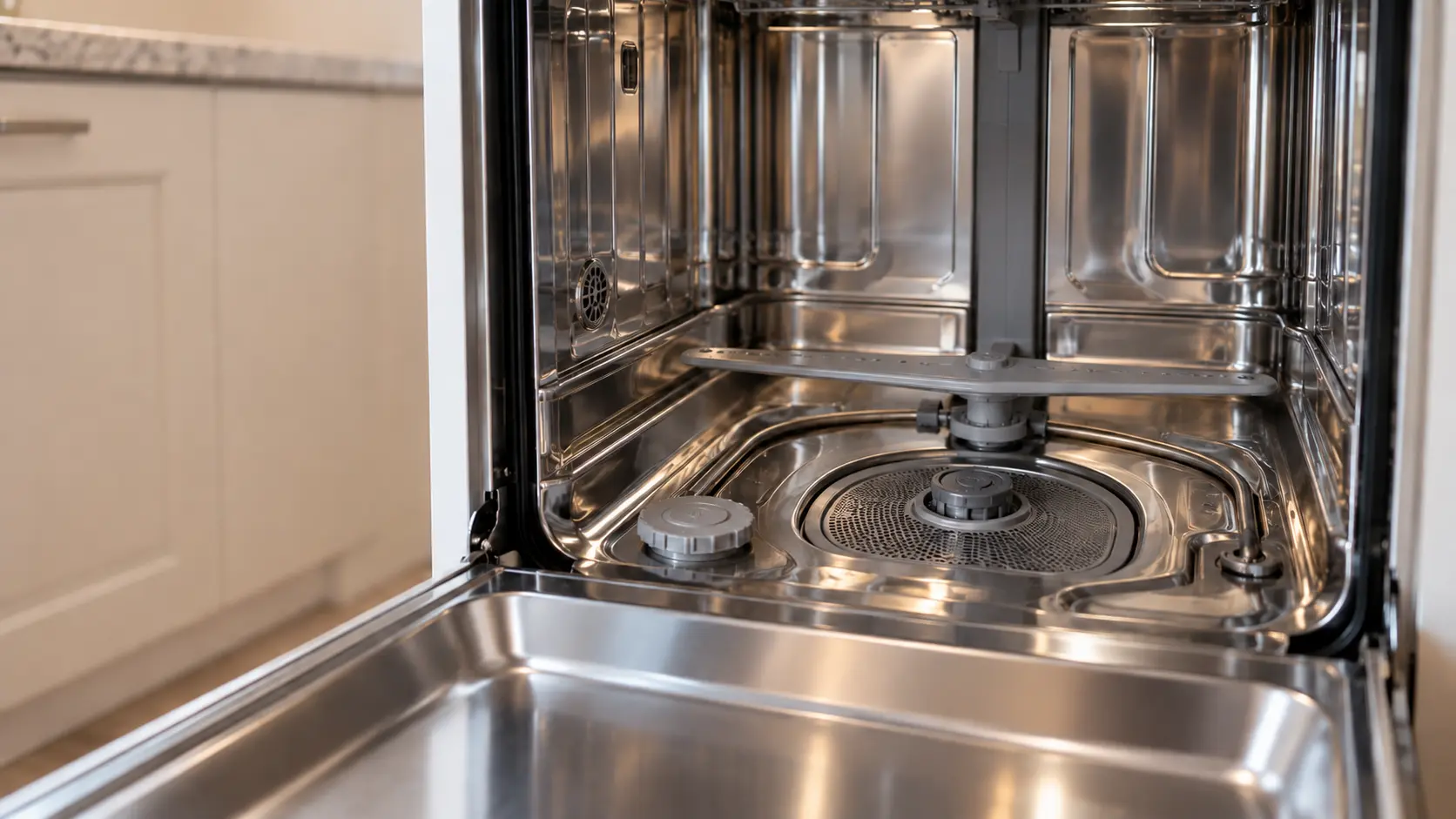
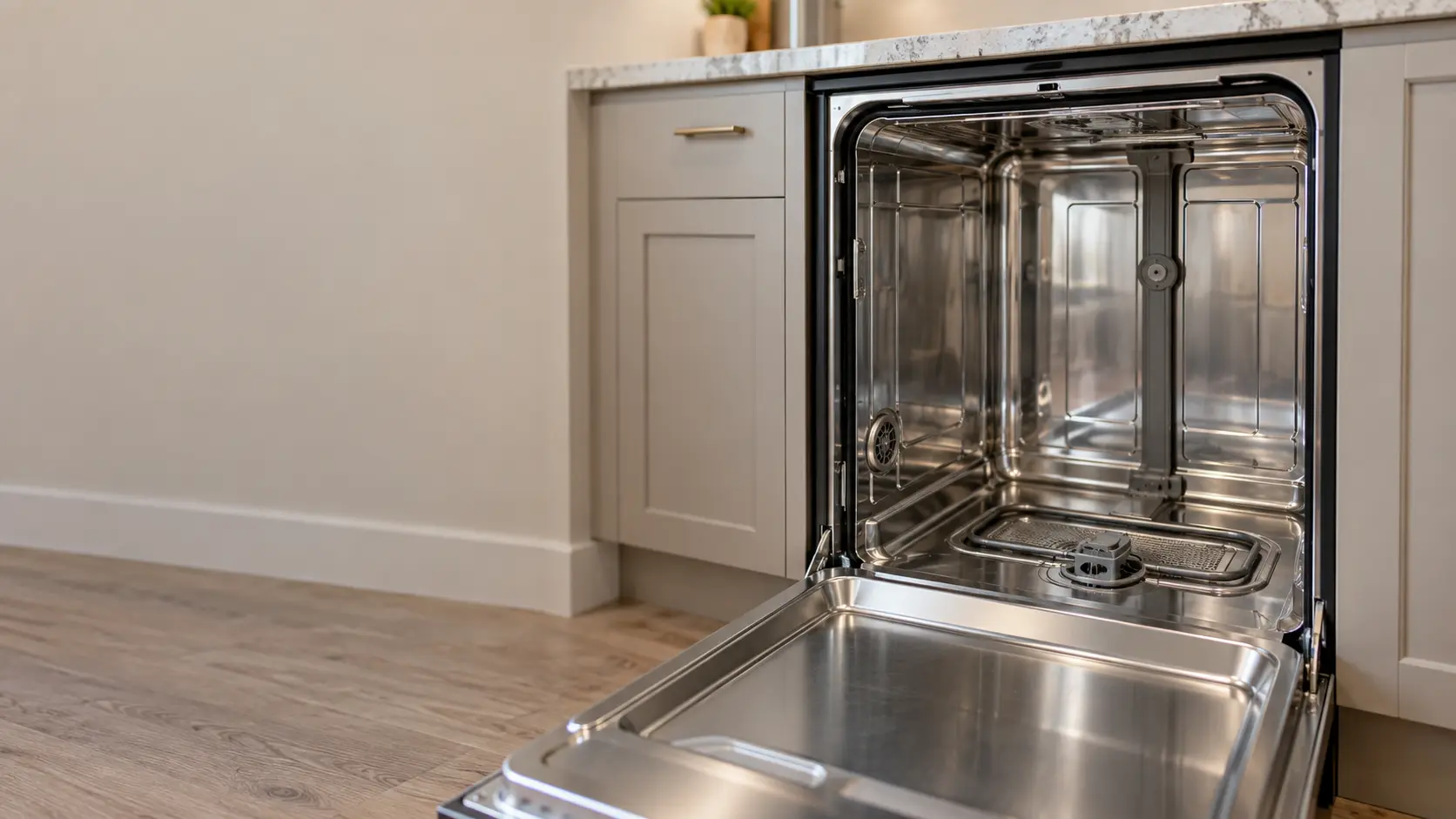
Once the tub has cooled, open the door and pull the lower rack all the way out. The heating element on many dishwashers is a looped metal tube lying on the tub floor, and a lid or a small spatula that drops through the rack will melt onto it. That smell is sharp and acrid, strongest inside the tub, and ends once the plastic is scraped off the cold element with a wooden or plastic tool.
A smell that is stronger at the kick plate than inside the tub is a different matter. It comes from beneath the machine, where the pump motor, the wiring harness and the power connection sit. Hot insulation has a heavier, fishy or scorched odor that people often describe as unlike anything else in a kitchen.
The one reset
If the smell was plastic on the element, the floor is dry and nothing else on the circuit was running, a single reset is reasonable. Push a panel breaker fully to off and then back on; press the reset button on a GFCI outlet firmly until it clicks. Then run a short rinse and stay in the kitchen.
If it trips again, stop there. Repeated resets make a failing connection hotter each time, and a GFCI that keeps opening is doing its job.
- Trips a second time: leave it off and book.
- Hot smell with no melted plastic in the tub: leave it off and book.
- Discolored outlet or cord in the sink base: leave it off and call an electrician first.
- Trips only when the disposal runs as well: the circuit layout is the question, not the dishwasher.
What a technician checks
The visit starts with power off at the panel and the kick plate removed. The technician opens the junction box cover to look for darkened wire ends or a loose connector, measures the element's resistance and its insulation to the tub, and checks the pump motor and harness for moisture. On a cord-connected machine the plug and outlet are part of the inspection.
Most of these finds are a single part. The one that changes the conversation is heat damage to the harness or the terminal block, because it usually means a leak has been reaching the electrical side for some time.
For a dishwasher tripped breaker with no smell and no water in sight, the technician may also ask an electrician to test the circuit itself, because an aging breaker can begin tripping below its rating. That test happens at the panel, not at the machine.