

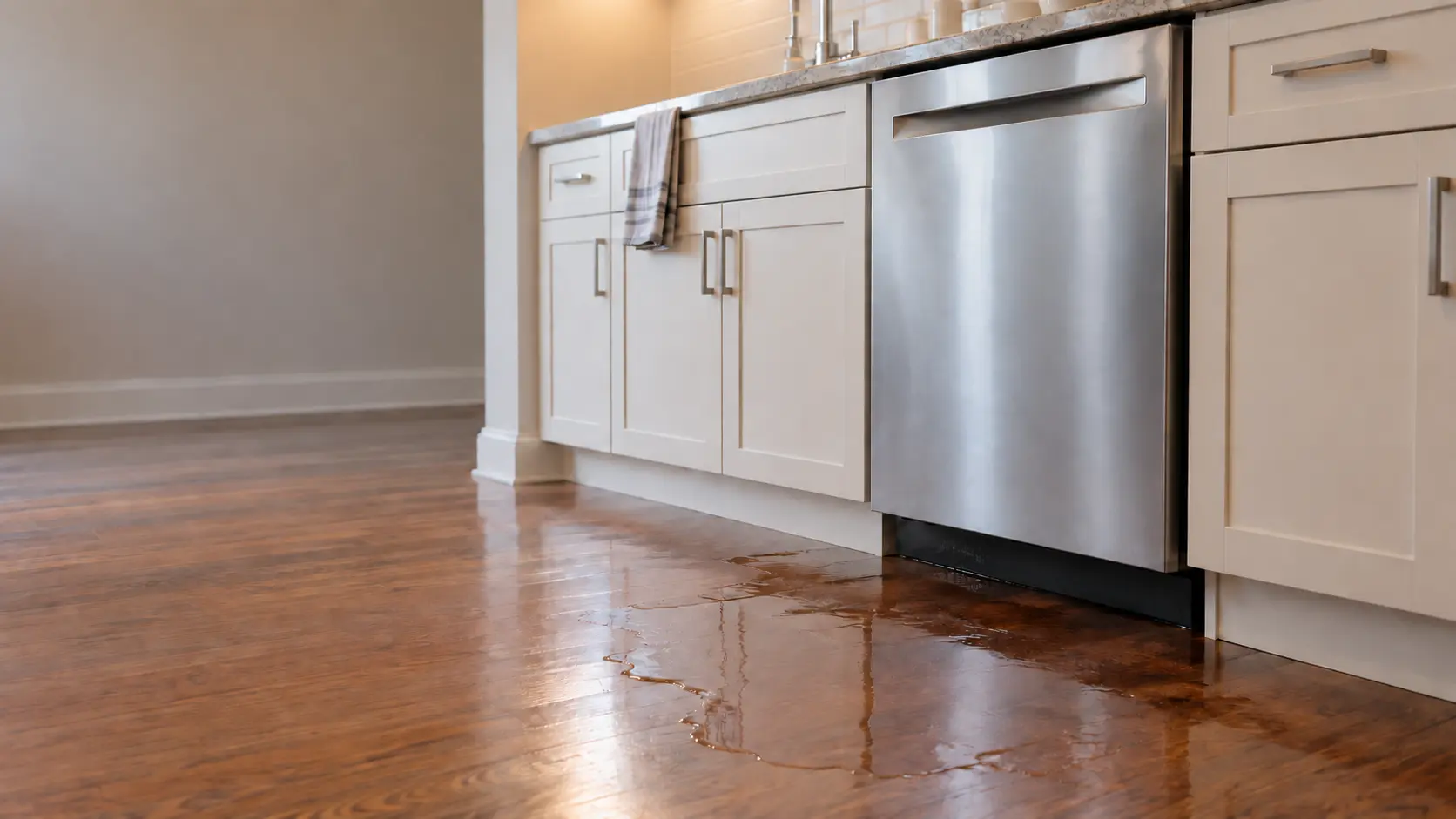
Map the puddle before you mop it
Water spreads and follows the floor, so the first minute matters. Before drying anything, note whether it reached the kitchen from under the door, from under the toe kick or from the sink cabinet. A flashlight held low to the floor shows the wet path clearly on tile and wood.
If you are still wondering why is my dishwasher leaking after that first look, run a short rinse with a dry paper towel laid along the front edge and another pushed under the toe kick. The towel that darkens first tells you which half of this guide to read.
Leaks at the door
Suds from the wrong detergent
A squirt of hand dish soap, or a bottle refilled by mistake, makes foam that pours out past the door within minutes. The same happens in miniature with too much rinse aid or a spill of it left on the door. A tub full of bubbles is the giveaway; scooping out the foam and running two or three rinse-only cycles clears it without any repair.
The tub gasket and the lower door seal
Two seals keep the water in. The tub gasket is the rubber tube pressed into a channel around the sides and top of the opening, and it tears or flattens with age. The second is a flexible strip or rubber blade along the bottom of the door, which dries out, cracks, or curls under after a hard close. Food stuck on either breaks the seal as surely as a tear does.
A machine that is not level
A dishwasher that tilts forward sends its wash water toward the door rather than toward the sump. Put a small level on the open door and on the rack rails; a machine leaning even a little forward can leak only on its heaviest cycles. Loose mounting brackets under the counter lip let the whole tub shift when the door is pulled down.
Source: Whirlpool — Leaking from the door — Dish soap suds, a blocked or worn seal, and an unlevel tub

Leaks from underneath
Behind the toe kick sit the connections that carry water in and out, and each can drip. The supply line meets the inlet valve at a brass elbow near the front left or right corner; a fitting that was never quite tight or a cracked plastic valve body weeps slowly and steadily. The drain hose leaves from the pump, and a clamp that loosened there leaks only while the machine is pumping out.
The pump itself has a shaft seal, and a worn seal leaves a mineral trail on the base pan below it. A crack in the plastic sump, or a rusted-through spot in an older tub, is less common and usually shows as a stain that returns after every cycle.
- Water on the floor only during fill: the inlet valve or supply connection.
- Water only while draining: the drain hose clamp or pump outlet.
- Water during the whole wash: the pump seal, the sump or a heater gasket.
Source: Whirlpool — Leaking underneath — Check the supply elbow connection and the drain hose
When the machine stops itself
Many current dishwashers have a shallow base pan with a float or sensor in it. When water collects there, the control stops filling and runs the drain pump, and some brands show a code or a flashing light. The machine may seem dead with no water on the floor at all, because the pan caught the leak first. Emptying the pan and running again only hides the question; the water came from somewhere above it.
A dishwasher drawer is sealed differently. Its tub is closed by a lid that lowers onto it inside the cabinet, and a worn lid seal or a drawer that does not close square spills water over the front. The flexible hoses that follow the drawer in and out are another point of wear, especially on a double drawer used many times a day.
Base pans hide leaks in the other direction too. A pan that has been catching a slow drip for months can hold a small amount of water without the float rising, and the only sign is a musty smell from the toe kick or rust on the frame legs.
Source: Whirlpool — F8E4 error code — Water in the drip tray trips a float switch and starts a drain
Water in the sink cabinet
Water inside the sink base, rather than under the dishwasher, points to the connections there: the hose clamp on the disposal or the sink tailpiece, the air gap, and the shutoff valve's packing nut. An air gap that is clogged sends water out of its cap onto the counter during the drain, which is easily mistaken for a sink leak.
On a panel-ready model the cabinet front hides the toe kick and the side panels, so a slow leak often shows first as a swollen cabinet edge or a darkened floor next to the opening. Compact portables drip where the hose meets the faucet adapter, which is visible right at the sink.
- A wet disposal side: the hose clamp at the inlet has loosened or the hose has split at its end.
- A wet valve: the packing nut behind the handle or the compression nut on the supply line.
- A wet cabinet floor with dry connections: water running down the hose from a leak higher up.


