What hard water is, in numbers
Hardness is the amount of dissolved calcium and magnesium in the water. Utilities usually report it in milligrams per liter, while dishwasher manuals and water softener companies use grains per gallon. One grain per gallon is about 17.1 mg/L, so the conversion takes a calculator and a minute.
The US Geological Survey sorts water into four classes by the milligram figure. Hardness varies widely between regions, and USGS points homeowners to their local water utility for the figure that applies to their own tap.
- Soft: 0 to 60 mg/L, roughly 0 to 3.5 grains per gallon.
- Moderately hard: 61 to 120 mg/L, roughly 3.5 to 7 grains.
- Hard: 121 to 180 mg/L, roughly 7 to 10.5 grains.
- Very hard: more than 180 mg/L, above about 10.5 grains.
Finding your own number
Public water systems publish an annual Consumer Confidence Report, and many list hardness in it. If yours does not, an inexpensive test strip dipped in a glass of cold tap water gives a reading in seconds. Homes on a private well should test, because hardness can be far higher than the town's supply.
Source: USGS Water Science School — Hardness of water — Soft to 60, moderate to 120, hard to 180 mg/L, then very hard; EPA — Consumer Confidence Reports: information for consumers — Water systems send customers an annual drinking water quality report
How rinse aid works
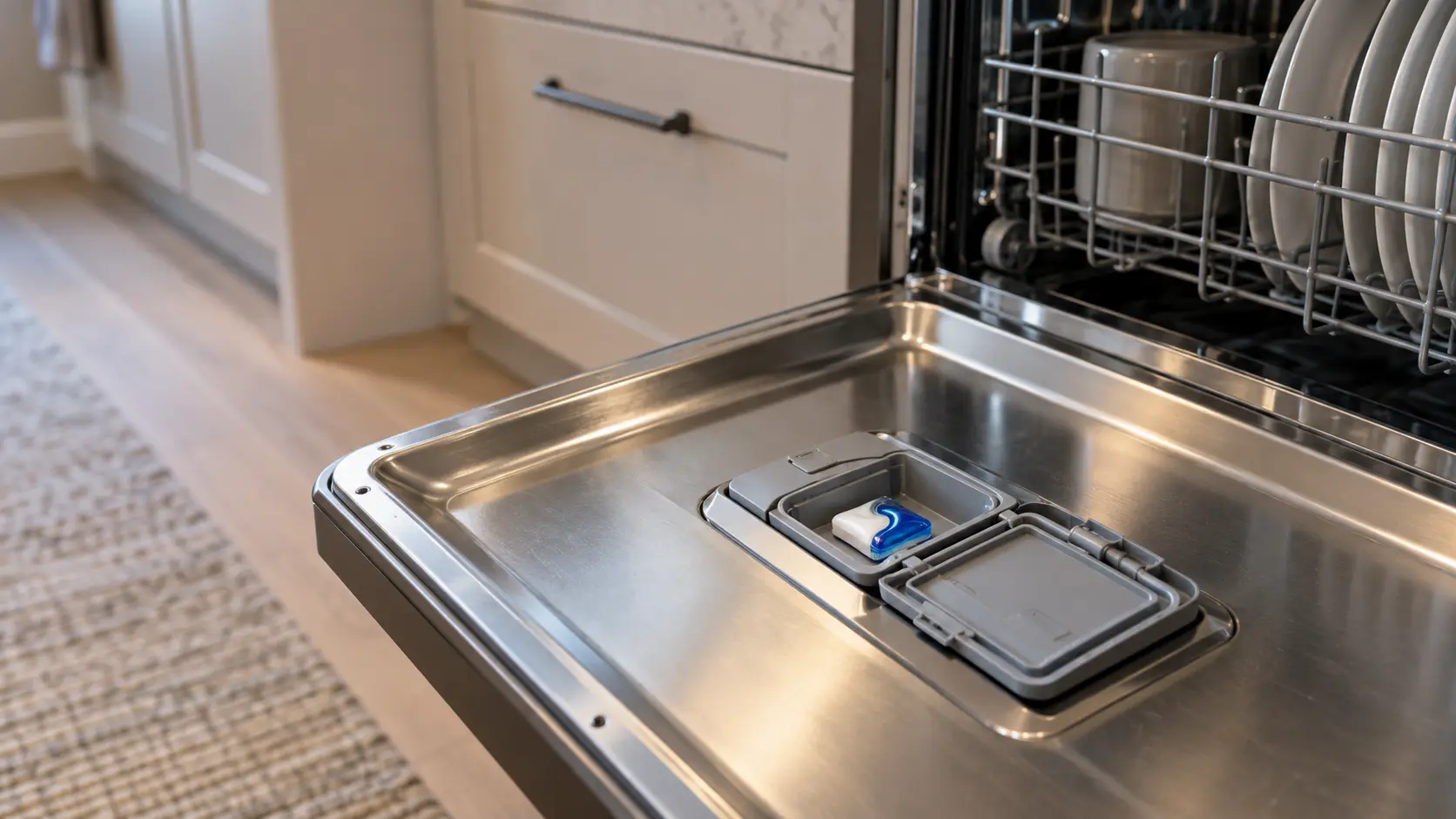
Rinse aid is a surfactant released into the final rinse. It lowers the surface tension of the water so it runs off glass and plates in a thin sheet rather than sitting in drops. Each drop that dries in place leaves its minerals behind, which is what a spot is.
It matters for drying too. Many current machines dry by condensation, with no exposed heating element, and they depend on water leaving the dishes quickly. Without rinse aid, plastics and the tops of upturned cups stay wet, and some makers state that drying results assume it is being used. That is why rinse aid for hard water is not an optional extra on these designs: it does double duty, against spots and against wet plastics.
The dispenser setting
Most dispensers have a dial or a menu setting from low to high. Start in the middle. Streaks and a bluish, greasy look mean too much, so turn it down one step; spots and wet dishes mean too little, so turn it up. Give each change a few loads before judging.
The water hardness setting
Many machines also ask for your hardness level in their settings menu, and some models have a built-in softener that uses dishwasher salt. The hardness setting adjusts how much the softener regenerates or, on models without one, how the cycle is run. It is often left at the factory default, which is rarely your water.
Vinegar is not a substitute
Vinegar does not belong in the rinse aid compartment either: it does not lower surface tension the way rinse aid does, and the dispenser is meant for the product its manual names. Keep vinegar for the test below and for an occasional cup placed on the top rack.
Source: Whirlpool — How to fill and adjust the rinse aid dispenser — Rinse aid makes water sheet off; efficient machines depend on it; Whirlpool — Water hardness setting — Softener ships switched off; set the hardness and add softener salt

Film or etching: the vinegar test
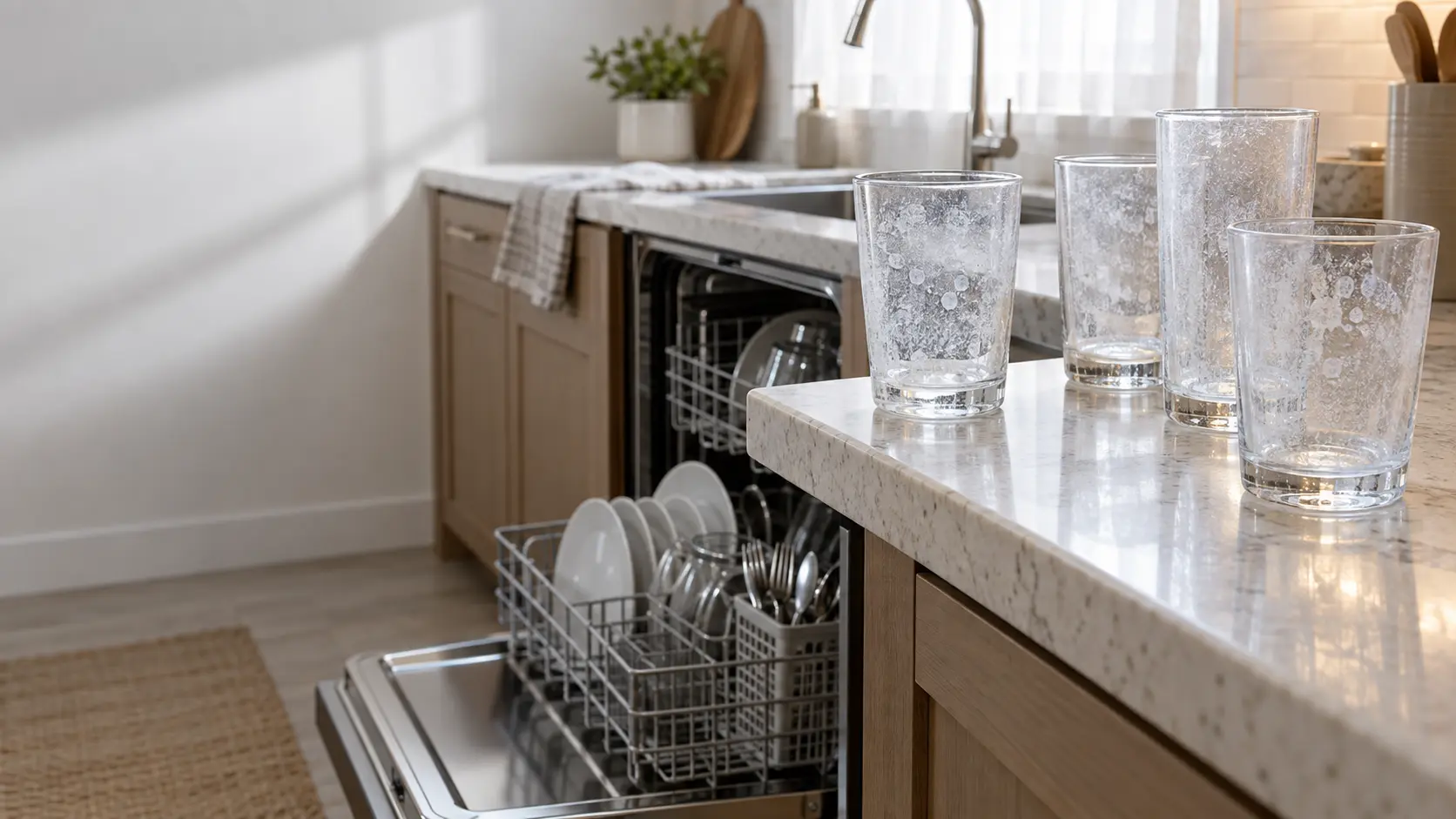
Stand one of the hazy glasses in a bowl of white vinegar, wait a few minutes and rinse. If it comes out clear, the cloud was mineral film, and hardness settings, rinse aid and a descaling cycle will cure it.
If the glass stays cloudy, rainbow-tinted or rough to the fingernail, the surface is etched. Etching usually comes from soft or softened water combined with too much detergent and very hot water. It is permanent, so the fix is prevention: less detergent, a lower temperature option for glassware, and hand washing for crystal.
A quick way to see which problem you have without a soak: run a fingernail over the cloudy spot. Mineral film feels slightly gritty and can sometimes be scratched off; etching feels smooth because the damage is in the glass, not on it.
Source: Whirlpool — Etching or cloudy glassware — Vinegar tells film from etching; softener advised above 15 grains
Softeners and dishwasher salt
In very hard areas, the real cure is softer water. A whole-house softener exchanges calcium and magnesium for sodium before the water reaches any faucet, and most dishwashers then need less detergent and hardly any descaling.
A few dishwasher models, mostly European designs, carry their own small softener with a salt reservoir under the lower spray arm. Fill it only with coarse dishwasher salt, never table salt, and set the hardness in the menu so the machine knows how often to regenerate.
- Salt goes in the reservoir only, with the funnel supplied; spilled salt in the tub can corrode the steel.
- Refill when the salt indicator lights, which may be months apart in moderate water.
- If the house already has a softener, the dishwasher's own softener can often be set to its lowest level.
Source: Whirlpool — Water hardness setting — Softener ships switched off; set the hardness and add softener salt; Whirlpool — Etching or cloudy glassware — Vinegar tells film from etching; softener advised above 15 grains
Keeping scale out of the machine
Scale builds up inside the machine as well as on the dishes. It crusts on the heating element, narrows spray arm holes and roughens the inlet screen, which slows every fill.
- Use a detergent labeled for hard water, or add a separate booster if your hardness is high.
- Where the water is very hard, descale with a citric-acid product in an otherwise empty tub every month or two.
- Keep the rinse aid dispenser topped up; most have a window or indicator light that shows when it is low.
- If the home has a whole-house softener, lower the dishwasher's detergent dose to avoid etching.
Source: Whirlpool — Etching or cloudy glassware — Vinegar tells film from etching; softener advised above 15 grains