
Cloudy Glasses and White Residue
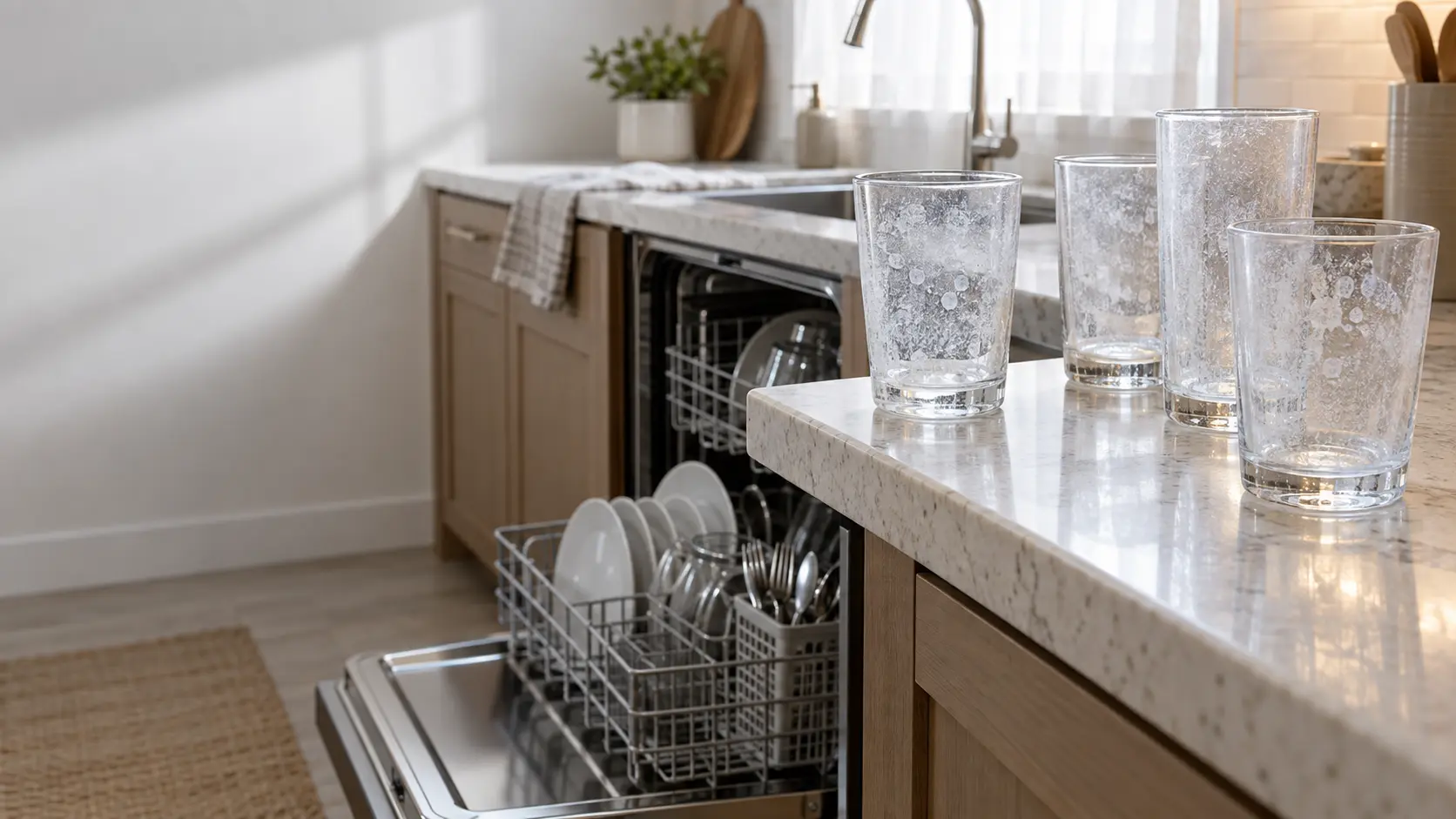
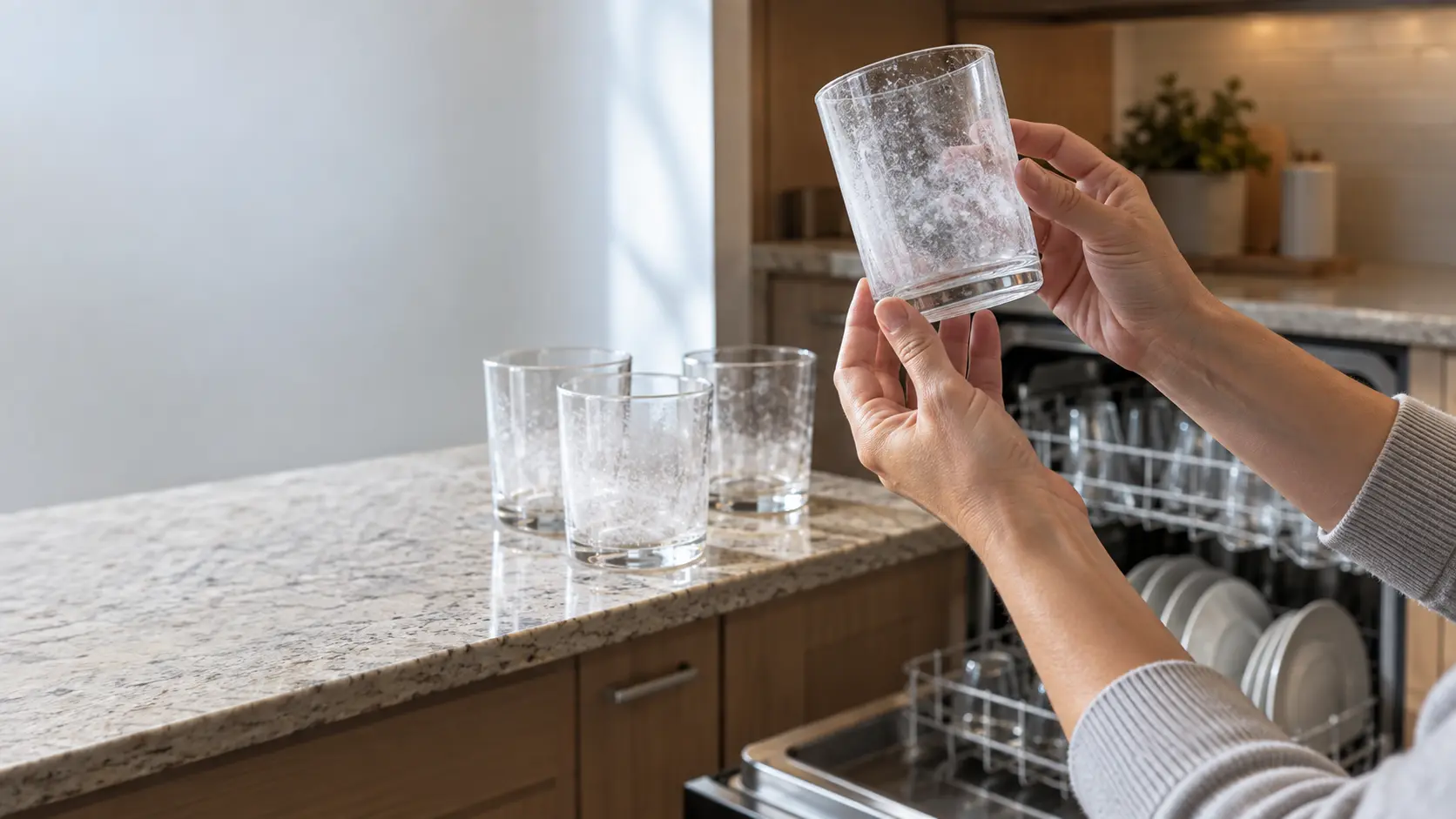
Glasses come out cloudy or spotted, and dishes carry a white chalky or gritty film.
Mon–Sat, 8am–8pm
- 5 checks before you book
- 5 questions that narrow it
- 6 causes, cheapest first
Book a visit
Three short steps, about a minute.
or call (844) 430-4286
Loading appointment form…
The appointment form couldn’t load. Please try again.
What it
usually means.
A white film has two very different sources. Hard-water minerals and undissolved detergent leave a deposit that comes off with vinegar; etching is permanent damage to the glass surface from soft water and too much detergent. A simple test tells them apart: soak a cloudy glass in white vinegar for five minutes. If it clears, it is a deposit, and the fix lies in rinse aid, detergent and water.
 The 6 causes, cheapest first
Answer these first
Does the film wipe or soak off with vinegar, or stay on?
Is the residue chalky and white, or gritty and sandy?
Do you have hard water, or a water softener at home?
Is rinse aid in use and is the dispenser full?
Is the residue on everything, or mainly glassware on the top rack?
Check these
before you book.
Dishwasher leaving white residue on dishes: 5 checks, and none of them costs anything.
Soak one cloudy glass in white vinegar for five minutes to see whether the film is a deposit or etching.
Fill the rinse aid dispenser and raise its setting a step if spots continue.
Run an empty cycle with a cup of vinegar on the top rack, or a dishwasher cleaner, to remove buildup in the tub.
Also worth checking
- Match the detergent dose to your water; use less with softened water.
- Clean the filter and flush the spray arm nozzles.
How soon does it need a visit?
Not urgent. Residue is a quality issue, not a safety one, and the machine can keep running while you adjust detergent and rinse aid.
The causes,
cheapest first.
6 things cloudy glasses and white residue turns out to be, from hard water minerals to water not reaching temperature.
The cost guide-
01 no repair
Hard water minerals
Calcium and magnesium dry onto glass as spots and a haze. A rinse aid and a detergent with a hard-water booster reduce it a great deal.
-
02 no repair
Too much or too little detergent
Too little leaves minerals behind, and too much leaves detergent itself. Pods remove the guesswork but can be too strong with softened water.
-
03 no repair
Glass etching from soft water
Soft water and strong detergent slowly roughen the glass surface. It does not come off, and it cannot be repaired, only stopped.
-
04 lowest
Filter or spray problem leaving grit
A gritty rather than chalky film is usually food particles recirculated by a dirty filter or blocked nozzles.
-
05 low
Rinse aid dispenser not releasing
The dispenser may be full but not dosing, so spots return even with rinse aid in the machine.
-
06 low to moderate
Water not reaching temperature
Detergent dissolves poorly in cool water and redeposits on the load. It often comes with poor drying.
What else
it could be.
Most often confused with dishwasher not cleaning dishes, then dishwasher detergent not dispensing.
All problems


The makes
it happens on.
27 makes on this site; cloudy glasses and white residue can show up on any of them. Each mark opens that make's own page.
All 27 brandsCloudy Glasses and White Residue,
where we come out.
9 metros, each with its own page.
All service areasTampa BayFL · 31 areas
Miami / South FloridaFL · 47 areas
New York MetroNY · 75 areas
HoustonTX · 36 areas
ChicagoIL · 50 areas
Los AngelesCA · 95 areas
San DiegoCA · 31 areas

Questions about
cloudy glasses and white residue.
How do I know if my water is hard?
Can etched glasses be restored?
Does a water softener fix the residue?
Is it the dishwasher or the detergent?
Back to your everyday
Still seeing cloudy glasses and white residue?
Book with what you checked above — 5 answers save the technician the first part of the visit.